
Introduction
Onyx is the show-stopper of natural stones: translucent, richly veined, and unmistakably luxurious. When selected and installed well, it transforms reception areas, feature walls, bars, and vanities into statement pieces—especially when backlit. This guide explains onyx types, best applications, finishes, thickness, pricing drivers, maintenance, mistakes to avoid, and how to choose premium slabs with confidence.
Looking for curated premium slabs? Explore our selection of Onyx and get tailored advice from our team in Carrara. (Click)
What Makes Onyx Unique?
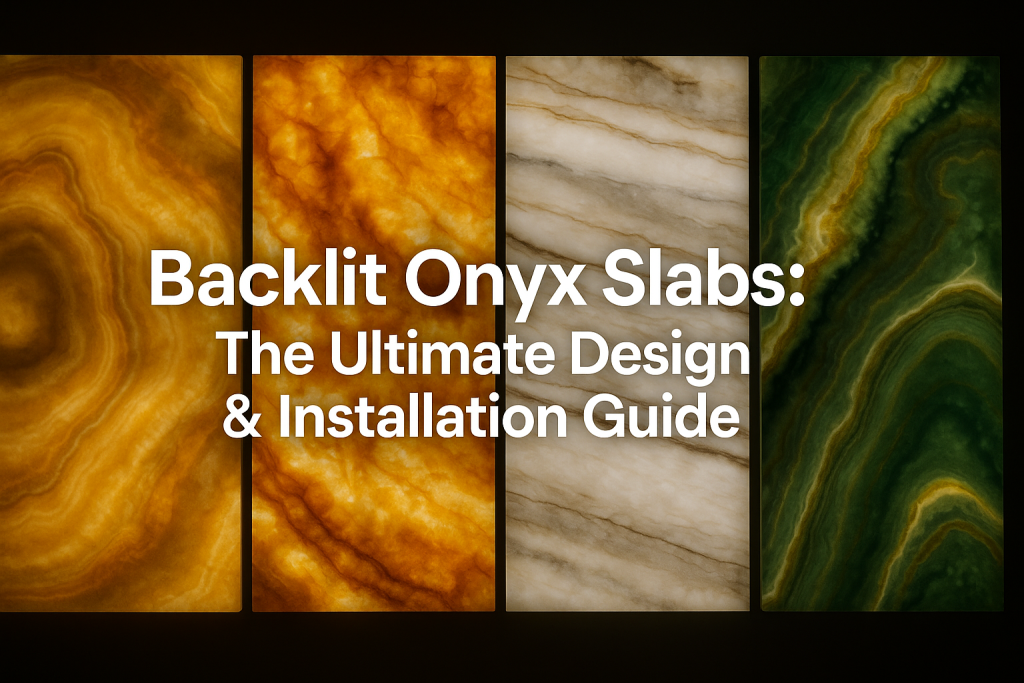
Translucency: Many onyx varieties transmit light, enabling dramatic backlit walls, reception desks, and countertops.
Striking veining & colorways: From soft creams and honey tones to emerald greens and dramatic blacks/whites, patterns can read like abstract art.
Luxury positioning: Onyx is often specified in high-end residential and hospitality projects for signature surfaces and focal points.
Tip: Some varieties marketed as “translucent” are especially prized for light panels and feature walls. (Click)
Popular Onyx Colors & Looks
White & Ivory Onyx – Minimal, luminous, ideal for contemporary backlit walls.
Honey/Amber Onyx – Warm, golden movement; a classic for bars and lobbies.
Green Onyx – From pale jade to deep emerald with dramatic contrast; stunning for art-like installations.
Multi-color & Veined Onyx – High contrast banding for bold, sculptural spaces.
Browse current availability and colors in our Onyx category to see what’s in stock. (Click)
Where Onyx Works Best (and Why)
Best uses:
Feature / Backlit Walls & Panels – Make the translucency the hero.
Reception Desks & Bars – A focal element guests won’t forget.
Vanities & Niche Surfaces – Low-impact horizontal use with proper protection.
Use with care:
Kitchen countertops – Possible, but plan for sealing, trays, and mindful use (avoid harsh acids/abrasives).
High-traffic floors – Choose harder stones (e.g., quartzite or marble with specific finishes) if heavy wear is expected.
Finishes, Thickness & Formats
Polished – Maximizes color depth and mirror-like reflection; most common for walls and statement pieces.
Honed – Softer sheen; reduces glare under strong backlighting.
Leathered / Brushed – Adds tactile dimension and diffuses light.
Typical thickness – 2 cm for walls and panels; 3 cm or laminated builds for bars/counters needing extra rigidity.
Book-matching & end-matching – For continuous veining across large features.
Pricing 101: What Drives Onyx Cost?
Block quality & rarity – Color purity, translucency, and vein continuity command premiums.
Slab size & yield – Larger, defect-free slabs reduce waste and speed fabrication.
Complexity – Backlighting preparation, honeycomb reinforcement, mitered edges, and book-matching add cost.
Logistics – Crating, transport, and access to skilled installers/fabricators.
Provenance & selection – Suppliers with strong quarry relationships can secure superior blocks more consistently. (Our team sources in Europe via trusted partners and joint ventures.) Coverings 2025
How to Choose Premium Onyx: A 7-Step Checklist
Define the focal point. Walls vs. counters? Backlit or ambient?
Shortlist 2–3 color families. Decide between minimal (white/cream) and bold (green/multi).
Evaluate translucency. Use a flashlight behind the slab edge; ask for light-box photos or a showroom demo.
Inspect the veining path. Seek balanced movement, consistent tone, and plan for book-match if needed.
Check structural soundness. Ask about mesh backing, resin work, and any natural fissures.
Confirm finish & thickness. Align with application and lighting plan (e.g., honed for very bright backlighting).
Plan edge details & seams. Mitered returns, minimal visible seams, and reinforced cutouts for sinks/bars.
Need expert eyes on your shortlist? Contact our team—Carrara showroom & US office available. (Click)
Backlighting Onyx: Quick Design Notes
Even illumination – Use LED panels or uniform grid lighting to avoid hot spots.
Ventilation & access – Leave service access for drivers and heat management.
Finish selection – Honed/soft sheen can improve diffusion; polished maximizes color depth.
Mockups – Always test a small panel with the actual LED temperature (e.g., 3000K vs 4000K) before final install.
Care & Maintenance (Made Simple)
Seal on install, then periodically. Follow fabricator guidance for frequency.
Daily cleaning. pH-neutral cleaner and microfiber; avoid lemon/vinegar/bleach.
Prevent etching/stains. Use coasters, trays, and mats on horizontal surfaces.
Professional restoration. Polishing/honing can refresh surfaces after years of use.
Onyx vs. Marble vs. Quartzite (Quick Compare)
| Feature | Onyx | Marble | Quartzite |
|---|---|---|---|
| Visual impact | ★★★★★ (translucent) | ★★★★☆ | ★★★★☆ |
| Hardness | ★★☆☆☆ | ★★★☆☆ | ★★★★★ |
| Best for | Backlit walls, bars | Floors, baths, counters | High-wear counters/floors |
| Care needs | Higher | Medium | Lower |
| Price band | Medium–High | Medium–High | Medium–High |
We also curate Marble and Travertine slabs for complete project palettes. (Click)
Spec Guide (for Designers & Fabricators)
Standard slab size: Ask current stock; larger net sizes simplify book-match features.
Thickness: 2 cm (walls) / 3 cm (horizontal) or laminated.
Reinforcement: Mesh backing; consider honeycomb panels for large cantilevers.
Lighting cavity: Typically 30–80 mm depending on system; confirm per LED panel spec.
Joints: Plan discreet seams; previsualize vein flow across elevations.
Why Source From a Specialized Onyx Supplier
Reputation in Carrara and strong ties with European quarries mean better access to top-tier blocks, faster allocation, and fewer surprises during fabrication. A knowledgeable supplier will also provide lightbox tests, book-match layouts, crating, and logistics support across markets (EU/US). Coverings 2025
Call to Action
Explore our current Onyx inventory and speak with our specialists for samples, lead times, and project matching—or visit us in Carrara. (Click)
FAQs
Q1: Is onyx suitable for kitchen countertops?
A: It can be, but it’s best for low-impact kitchens or secondary counters. Plan for frequent sealing, pH-neutral cleaning, and protective habits (coasters/trays).
Q2: What’s the best way to backlight onyx?
A: Use uniform LED panels or a dense grid, test color temperature on a sample, and consider a honed finish for diffused glow.
Q3: How thick should onyx be?
A: 2 cm is common for walls/panels; 3 cm or laminated builds are safer for horizontal or high-rigidity needs.
Q4: How does onyx pricing compare to marble or quartzite?
A: Onyx tends to be similar or higher, depending on translucency, color rarity, slab size, and book-match potential.
Q5: Do you offer sourcing support and showroom visits?
A: Yes—speak to our team or visit our Carrara/US locations for expert selection and logistics. (Click)